






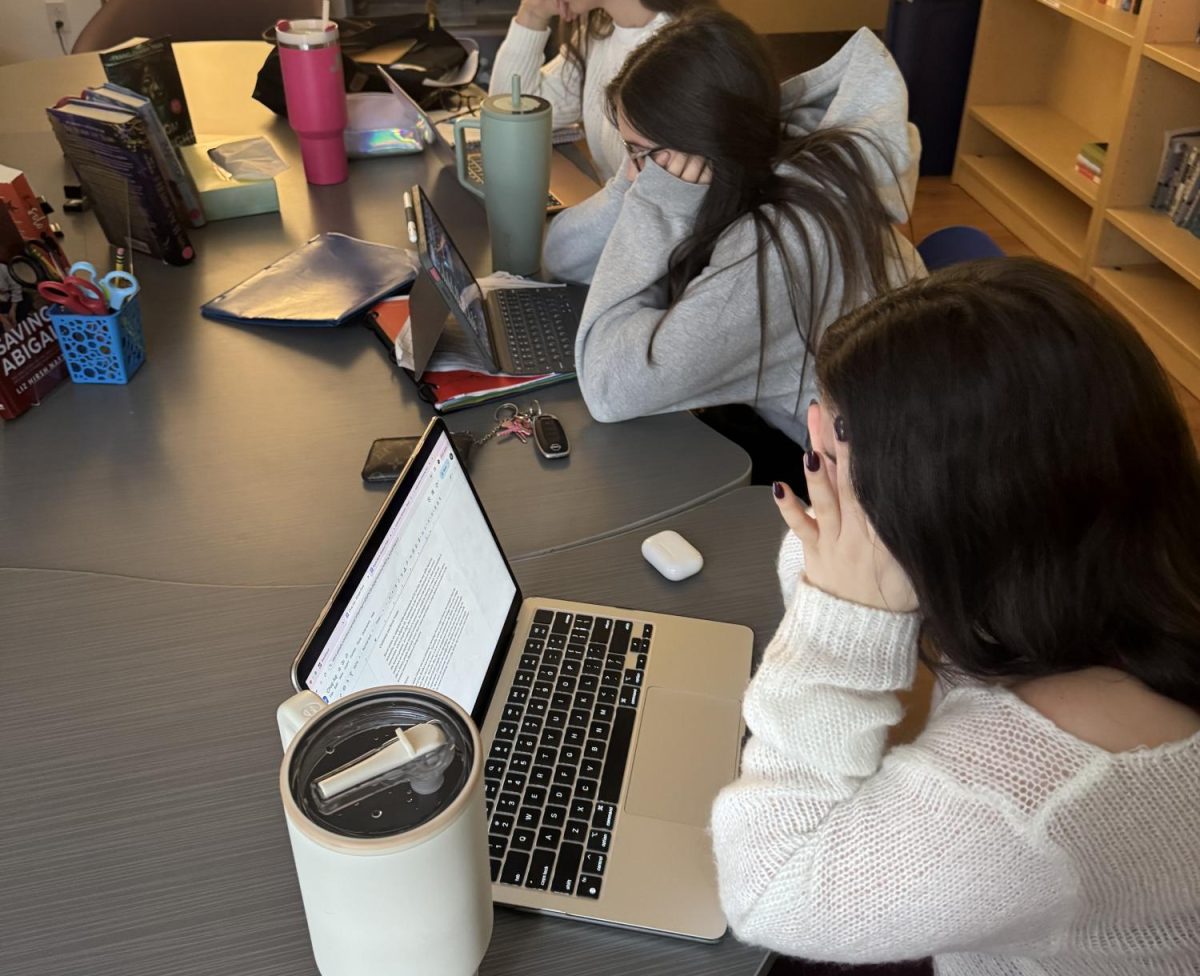














I’m gonna start by asking you all a simple question: when you wake up for school do you ever feel truly rested? If you feel that you don’t, you’re not alone, many teenagers feel this everyday including most students at school. The reason for this isn’t because we’re lazy or have bad habits, it’s because of biology. During our teenage years our biological clocks work differently and require a later start time and more sleep. I’m going to convince you that our school and others should start later because an 8:30 start time (the latest start time nationally) goes directly against how teenagers are wired and our sleeping habits affect performance, our health and overall wellness.
As I said before, teenagers naturally wake up later. Our biological clock and circadian rhythms naturally gravitate forward two hours. This can mean that teens don’t start to be tired until about 11 P.M. or later. Our brains release melatonin, the hormone that our body creates to make us sleepy much later during our teenage years than it does in childhood or adulthood. So when our school expects us to wake up as early as six A.M. to be on time to our first class it’s really the biological equivalent to an adult waking up at three A.M. We are fighting our biology every time we wake up and it doesn’t matter what time you go to bed because our brains won’t go to sleep because they just aren’t ready.
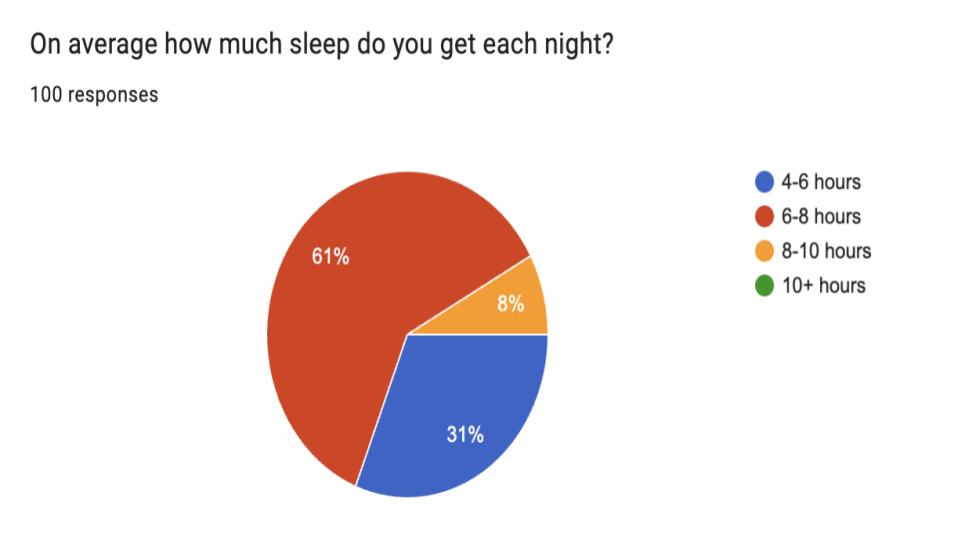
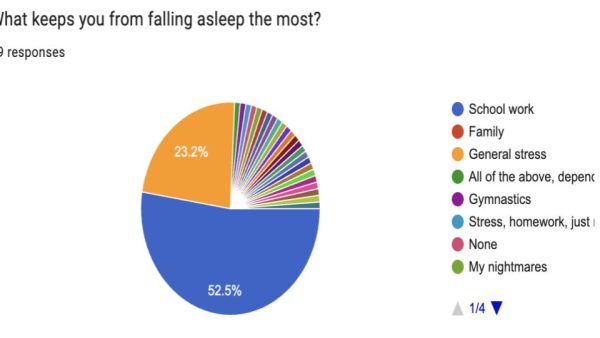
To see how this affects the lives of our students my group sent out a survey to discover personal anecdotes and research from our peers. These results were enlightening. 59.4% of students in the survey get only six to eight hours of sleep per night which is below the recommended eight to ten hours for teens. 31.1% get four to six hours. 8.6% get the recommended amount. When we asked if they felt they got enough sleep 79.9% said no. When you really think about it, four out of five of our own students walk into class everyday already sluggish and sleep deprived. The effects are shown through the rest of the survey with 91.4% of students saying that their lack of sleep affects their performance. This means that most of us think that our lack of sleep is due to a schedule we are forced to follow affects our grades, focus, motivation, mood, and extracurriculars. The final question was: what do teens feel is the leading cause of not falling asleep? 52.4% said schoolwork was the cause while 23% said general stress. We also got personal responses, where one said, “It is definitely school work which causes stress. Especially if you have sports, it isn’t realistic to get enough sleep to function properly. A later school start or lower workload are really the only ways to be able to get enough sleep.”
My group also interviewed a couple teens Jake T. (‘28), a dTHS student who starts school at 8:30 A.M. and Zane B., a Calabasas high student who starts school at 10:20 A.M. We asked on average how much sleep they get Jake said six to seven hours, lower than recommended for teens, whereas Zane said nine hours. Next they were asked if they think they get enough sleep, and Jake said he did not because he gets a lot of school work and gets home very late due to after school sports. In contrast, Zane said he thinks he should get more. Both said sleep affects their performance during the day. They also both agree that a solution to get more sleep would be if school started later.
Sleep affects our performance in all aspects of our life. Science proves this point again and again, sleep is crucial for our learning. When we don’t sleep our memory weakens, our reaction time decreases, concentration falters, problem solving gets harder, stress increases and test scores begin to drop. If we want to succeed in school I believe the solution may be a later start time.
With change comes challenges. A later start time could result in less instructional time which is unfair to teachers who have to cover a specific amount of material and students who are eager to learn. The benefits of having our future leaders coming to school well rested and excited to learn may be a major key to overall success and happiness. In addition, the current studies done by NCES (National Center for Education Statistics) on today’s teens involve academic surveys following diverse groups of students from public school, private school, charter school, and even homeschool children. With the data we have collected, we know that there are only two states in the U.S. that have mandated a later start time for teens (California and Florida), concluding that the subjects for these studies are all suffering with the same lack of sleep issues. I pose the question: would the findings at the NCES be the same and would students need to have this amount of time allotted for course study if everyone’s brains were working at full capacity in their well rested bodies? Ultimately changing the findings and recommendations of those studies by NCES.
The evidence is clear: the countless studies and our own research all point to the same thing: a later start time for schools. Educators across the nation say their priority is making sure we learn at our best, but they implement a schedule that is not conducive to teenagers’ biology.
Changing our school schedule will assist our community in deepening and expanding our education by supporting our mental and physical health. We are the future and deserve to be respected and perform at our greatest capacity which means a later start in school systems.
Thank you.