
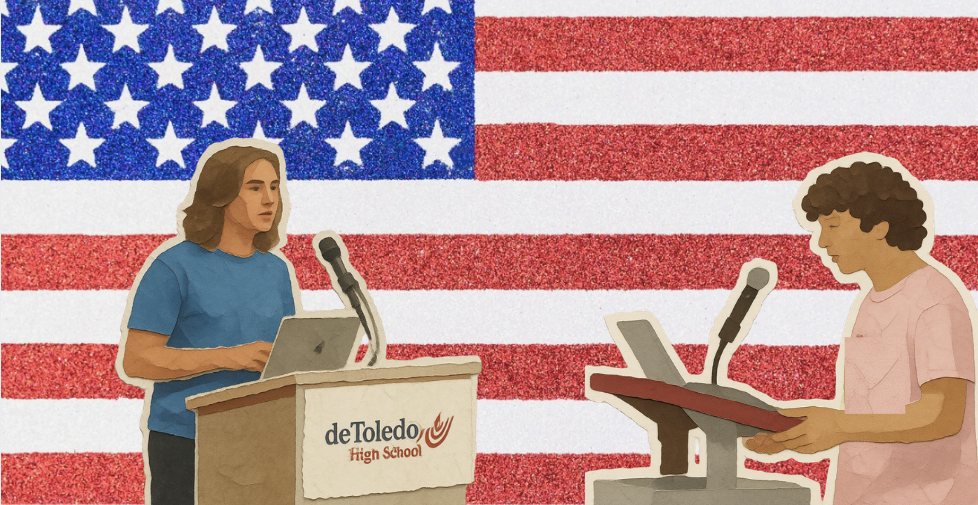
“The blue wave” that has swept the country is now leaving ripples throughout its people, bringing amplified attention to pre-existing political divisions. These listed eight states shocked the nation by flipping eight previously Republican-held Senate seats to Democratic control, some for the first time in nearly a century.
Following the midterm elections, the Democratic Party made significant gains in both chambers of Congress, reflecting a shift in the nation’s political landscape. These political changes have also influenced conversations across the country, where a growing chasm between political parties and rhetoric is increasingly combative.
Disagreement has been fundamental to America since its founding: disagreement over revolution, disagreement over centralized government, and disagreement about the interpretation of our constitution. However, disagreement becomes dangerous when opposing perspectives are illegitimized. In previous generations, political and social change occurred by groups appealing to capture the middle moderates. Now, the fringe extremists have stepped forward to claim leadership with every societal struggle.
This danger has always been embedded within our society. In his Farewell Address, President George Washington warned of hyperpartisanship: “Let me now […] warn you in the most solemn manner against the baneful effects of the spirit of party generally. This spirit, unfortunately, is inseparable from our nature, having its root in the strongest passions of the human mind […] and is truly their worst enemy.” To avoid this polarization, we need to broaden our perspectives to behave respectfully and engage in constructive conversation.
Last year I interned with the organization StandWithUs where I learned to combat conspiracy theory, antisemitism, and bias against Israel through engaging dialogue without directly challenging the absurdity of any claim. I learned how respectful questions such as “Why do you think that?” and “Where did you learn that?” begin to disarm even the most firm opinions. Citizens should learn to challenge ideas without demeaning those who hold them, and to recognize that disagreement does not make an opponent an enemy. Leaders must model these behaviors by engaging opposing viewpoints in good faith rather than exploiting division for gain.
In the musical Hamilton, Aaron Burr reflects on his fatal rivalry with Alexander Hamilton: “The world was wide enough for both Hamilton and me.” America is wide enough for competing beliefs, political parties, and visions of its future, even when those differences feel irreconcilable. A democracy does not require everyone to stand on the same side, but it does require tolerance for those who stand in different viewpoints.